
A reflection from HLTC 800 and the lived reality of healthcare inequity
There’s a moment in my course every week when something clicks – not because the material is new, but because it finally gives language to experiences I’ve been carrying for years. I’ll be reading about a policy structure or listening to a lecture on care delivery, and I’ll think, I’ve seen this before. Not in a classroom, but in conversations with friends, coworkers, and patients who were trying to navigate a system that didn’t feel built for them.
My interest in healthcare inequity didn’t start in graduate school. It started long before that, when I began really listening to the people around me. Friends who struggled to get answers about their coverage. Coworkers who couldn’t afford the care they needed. Patients who were doing everything “right” and still hitting barriers they didn’t understand.
Those stories stayed with me. They shaped me. And now, as I move through my learning, I’m finally able to connect those personal moments to the larger structures that created them.
Seeing the System From Two Angles
One of the most grounding parts of this course has been realizing how familiar the content feels, even when the terminology is new. When we talk about systems thinking, I’m not just learning about interconnected processes, I’m remembering the times when a single missing detail created a cascade of confusion for someone I cared about.
When we explore healthcare delivery models, I’m thinking about the people who never fit neatly into any model at all, the ones who fell through the cracks because the system wasn’t designed with their realities in mind.
It’s strange, in a way, to sit in class and realize that the “examples” we analyze are echoes of real people I’ve known. The patient who didn’t know her insurance changed. The coworker who couldn’t get time off for an appointment. The friend who didn’t have transportation. These aren’t hypothetical scenarios; they’re memories.
My course is helping me see the architecture behind those moments. It’s like someone finally turned the lights on in a room I’ve been navigating in the dark.
Where Inequity Shows Up
Healthcare inequity rarely announces itself. It doesn’t always look like a dramatic denial of care. More often, it looks like a thousand small barriers that accumulate until someone gives up, gets lost, or goes without.
- Insurance literacy: when a person’s entire care plan hinges on whether they understand a single sentence in a benefits document.
- Communication breakdowns: the moments when a rushed explanation leaves someone more overwhelmed than reassured.
- Access barriers: transportation, cost, time off work, language, digital access, childcare.
- Policy ripple effects: when a regulation written with good intentions creates unintended consequences for the people least equipped to navigate them.
These moments don’t always look like “inequity” at first glance. They look like confusion, frustration, fear, or silence. But once you’ve seen enough of them, you start to recognize the pattern.
Why This Matters for Future Healthcare Leaders
As I continue through my learning, I’m thinking a lot about what leadership means in a system where inequity is woven into the foundation. My course is pushing me to look beyond individual interactions and toward the structures that shape them.
Leadership, to me, is starting to look less like decision-making and more like pattern recognition.
It’s noticing who consistently struggles. It’s noticing who consistently waits longer. It’s noticing who consistently gets less information, less clarity, less support.
And then asking why.
It’s uncomfortable to acknowledge that inequity isn’t accidental, it’s structural. But that discomfort is also where change begins. If inequity is built, then it can be rebuilt. If it’s designed, it can be redesigned.
My learning is helping me understand the levers. My lived experience is helping me understand the stakes.
A Visual That Brings the Pattern Into Focus
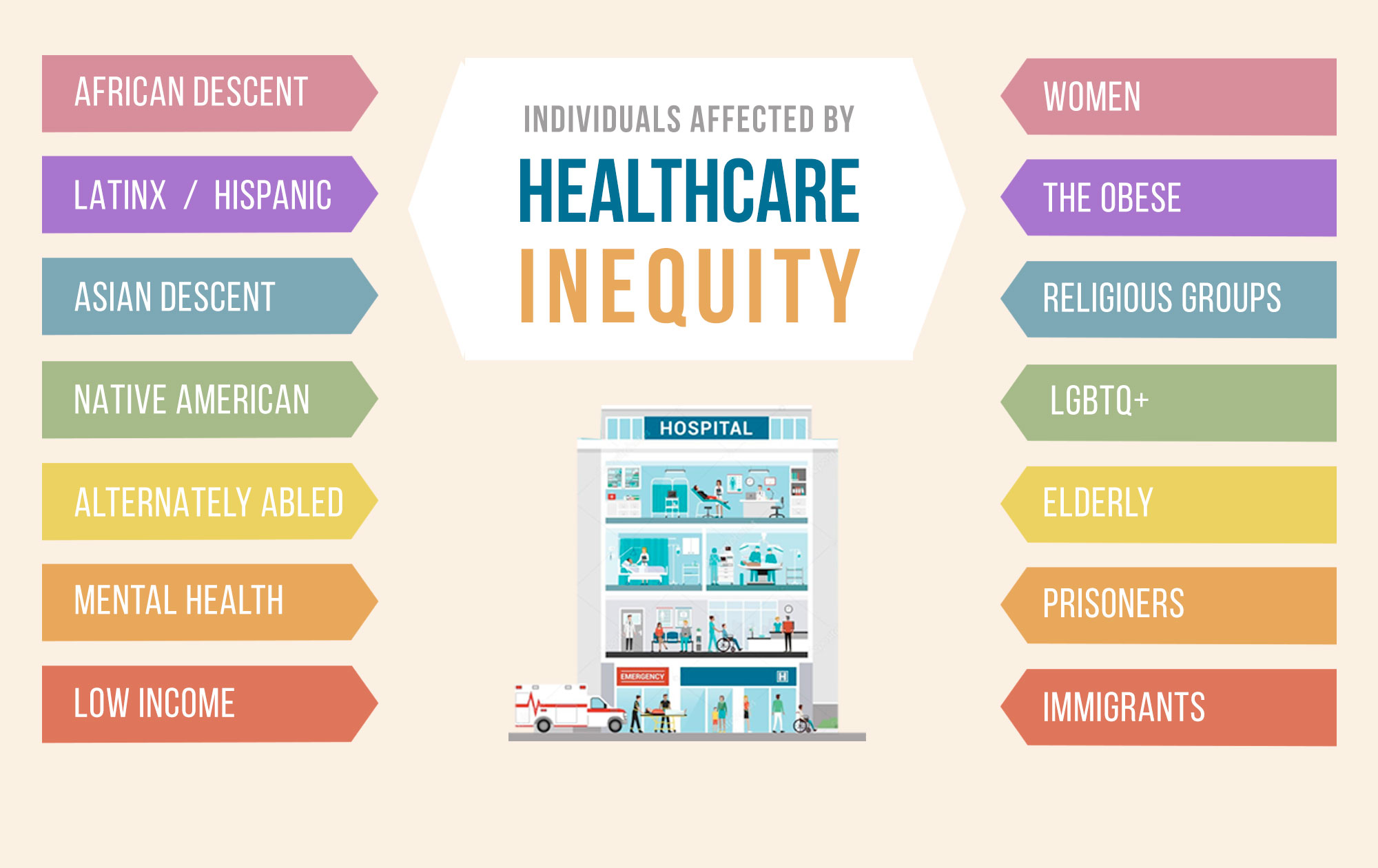
Toward the end of my reflection, I keep coming back to a graphic I’ve been using (see top of post); one that illustrates the many groups disproportionately affected by healthcare inequity. When I look at it, I don’t see categories. I see people I’ve known, people I’ve worked with, and people I’ve worried about.
It’s a reminder that inequity isn’t a single issue or a single story. It’s a pattern that touches entire communities in ways that are quiet, constant, and deeply human.
The Work Ahead
My interest in healthcare inequity didn’t start in a classroom. It started in the stories of people I cared about – friends, coworkers, patients – who were trying to make sense of a system that felt overwhelming, inconsistent, or unfair. Those stories shaped my perspective long before I ever opened a textbook.
Now, my course is giving me the framework to connect those moments to the larger system, and to imagine what a more equitable version of that system could look like.
This blog will be a place where I explore that intersection periodically: the academic, the personal, the structural, and the human. I want to write about the stories that shaped me, the policies that explain them, and the leadership approaches that might change them.
Because inequity isn’t inevitable. It’s visible. It’s measurable. And it’s something we can choose to address, not just in theory, but in practice.
 Help! Send Coffee!