In healthcare, words matter, especially when they describe the people who help patients navigate some of the most stressful moments of their lives. Two terms that often get used interchangeably are Patient Advocate and Patient Family Relations, but they’re not the same. In fact, the distinction shapes how patients experience care, how concerns get resolved, and how much support families truly receive.

Understanding the difference isn’t just a matter of semantics. It’s about knowing who is working for you, who is working with you, and how each role fits into the larger healthcare system.
What Patient Family Relations Does and Why It Exists
Patient Family Relations (sometimes called Patient Relations or Patient Experience) is a department within a healthcare facility. Their purpose is to help patients and families navigate concerns that arise during care.
Their role in the hospital
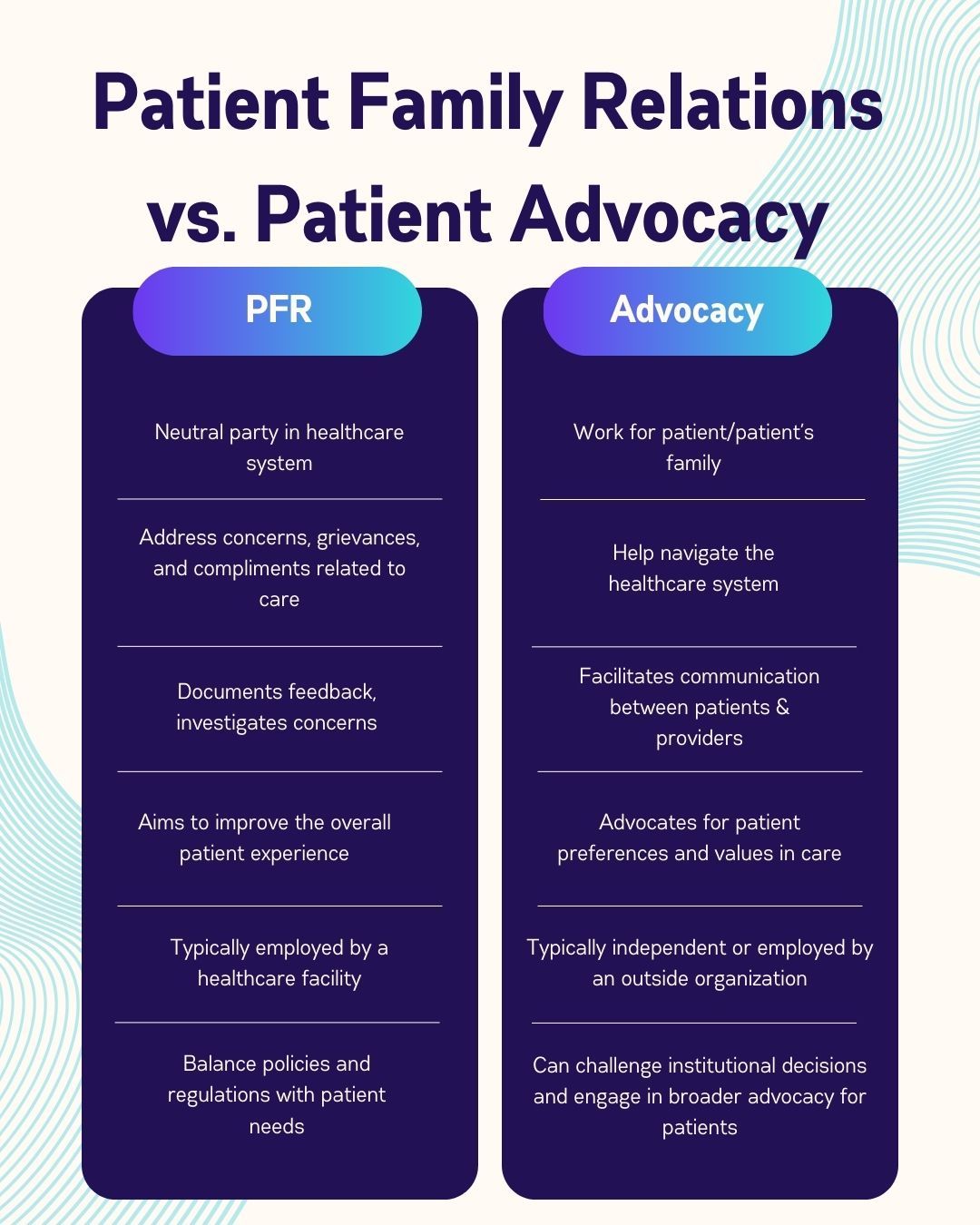
Patient Family Relations representatives act as neutral facilitators. They’re there to listen, gather information, and help resolve issues such as communication breakdowns, unmet expectations, or dissatisfaction with care. Often, the role does not get involved in immediate care needs, such as advocating for a patient who wants a specific procedure.
What they handle
- Investigating complaints
- Documenting feedback for quality improvement
- Clarifying policies or care processes
- Supporting communication between patients and clinical teams
- Ensuring patient rights are upheld within the hospital’s framework
Who they work for
This part is important: They are employees of the healthcare institution. Their work supports both the patient experience and the hospital’s operational and regulatory needs. They must balance patient concerns with policies, safety standards, and organizational priorities.
This doesn’t mean they aren’t patient‑centered. In fact, many are deeply committed to patient well‑being. However, their scope is defined by the institution.
What Independent Patient Advocates Do
Independent Patient Advocates operate outside the healthcare system. They’re hired directly by patients or families to provide personalized, one‑on‑one support.
Their role in the patient’s life
They work solely for the patient. Their job is to help people navigate the complexity of healthcare: medically, emotionally, and logistically. This means helping to advocate, in real time, the needs of the patient and the care they are receiving.
What they handle
- Facilitating communication with providers
- Helping patients understand diagnoses, treatment options, and care plans
- Supporting decision‑making based on the patient’s values and preferences
- Assisting with insurance or billing issues
- Challenging hospital decisions when necessary
- Coordinating care across multiple providers or settings
Who they work for
Their allegiance is 100% to the patient. Because they’re independent, they can push back on policies, escalate concerns, or explore alternative options without institutional constraints.
The Key Differences, and Why They Matter
1. Allegiance
- Patient Family Relations: Works within the hospital system
- Patient Advocates: Works solely for the patient
2. Scope
- Patient Family Relations: Resolves issues related to care within the facility
- Patient Advocates: Supports the patient across the entire healthcare journey
3. Ability to Challenge Decisions
- Patient Family Relations: Must operate within hospital policies
- Patient Advocates: Can challenge those policies on the patient’s behalf
Both roles are valuable. Both improve the patient experience. But they serve different purposes, and knowing which one you need can make a meaningful difference in how supported you feel.
Why This Distinction Matters to Me
In healthcare, people often reach out for help at moments when they’re overwhelmed, scared, or unsure of what to do next. In those moments, it’s not always obvious who they’re talking to — or what that person can realistically do for them. And that’s where misunderstandings can snowball.
From my seat in Patient Family Relations, I see how important it is for patients and families to understand the difference between speaking with someone who works inside the system and someone who works independently on their behalf.
When patients know who they’re talking to, a few things happen:
- Expectations become clearer. People understand what I can help with — and what may require a different kind of support.
- Concerns get resolved faster. When the right issues go to the right place, patients get answers more quickly and with less frustration.
- Patients feel more in control. Healthcare can feel like a maze. Knowing whether you’re talking to a hospital representative or an independent advocate helps you understand the kind of guidance you’re receiving.
- Trust builds more naturally. Transparency about roles helps patients feel grounded. They don’t have to guess whether someone is speaking from an institutional perspective or a patient‑centered one.
The goal isn’t to elevate one role over the other — both are valuable. It’s about helping patients understand the landscape so they can make informed choices about the kind of support they want and need.
At the end of the day, clarity is a form of care. And when people know who’s in front of them, they’re better equipped to navigate whatever comes next.
 Help! Send Coffee!