Working With Personality – Post 2
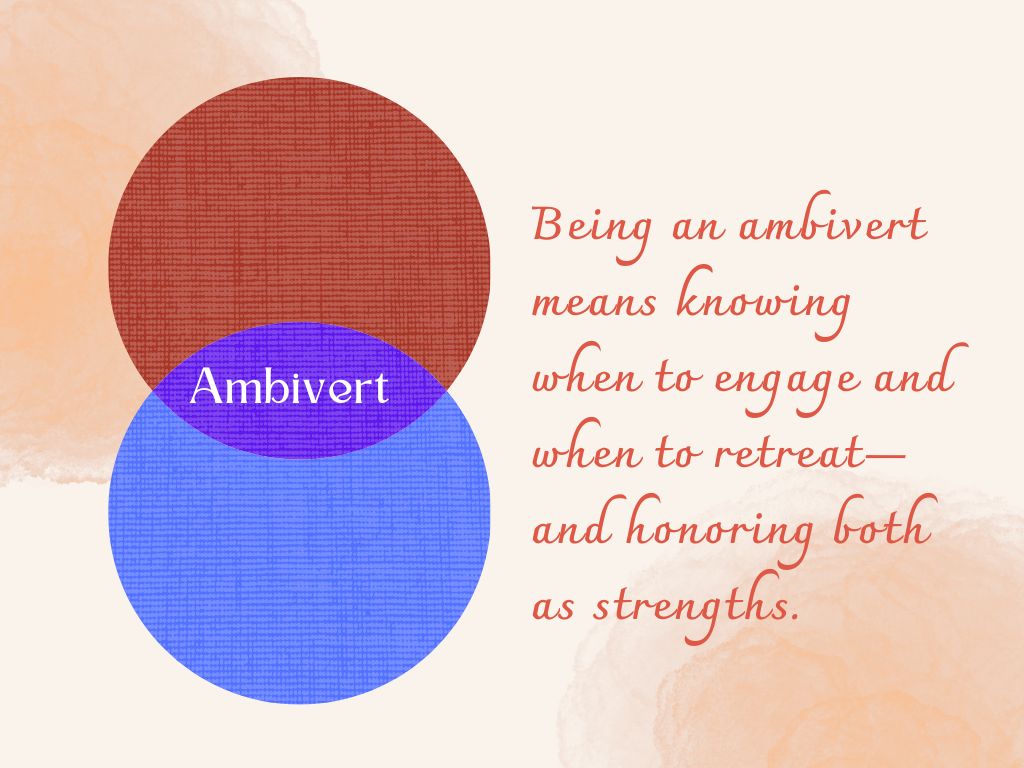
There’s a unique kind of tension in being both energized by people and drained by them.
As an ambivert, I live in that middle space. I can be fully present in a team meeting, lead a group project, or make conversation in a crowded room—and genuinely enjoy it. But when it’s over, I need quiet. Stillness. Recovery.
That’s the part people often don’t see. From the outside, I might look outgoing and social. Inside, I’m pacing my energy like a battery. When I don’t monitor that battery, I burn out—quickly.
Ambiverts are often called “flexible” or “balanced” personalities. But we’re more than that. We’re adapters. Translators. People who can bridge both ends of the spectrum—but sometimes feel misunderstood by both.
Defining the Middle: What Is an Ambivert?
Ambiverts fall between the extremes of introversion and extroversion. They can enjoy both social interaction and solitude and often shift between the two depending on context, mood, or energy levels. According to the Cleveland Clinic, ambiverts show strong emotional awareness and can read social cues effectively, making them excellent collaborators and empathetic leaders (Cleveland Clinic, 2023).
Scientific American adds that most people fall somewhere in the ambivert range—capable of focusing like introverts, but also socially engaged like extroverts. This dual capability allows ambiverts to regulate their mood and productivity more fluidly, which can be a major advantage in professional and academic life (Schultheiß, 2024).
The Dual Experience in School and Education
In classrooms, ambiverts often thrive in multiple formats: discussions, presentations, solo projects, group work. But this flexibility isn’t always recognized. Teachers may assume a student who participates confidently always wants to lead – or that a quiet day signals disengagement.
A recent article in the Journal of Language Teaching and Research showed that ambiverts tend to use a broader range of learning strategies than other personality types, including metacognitive and affective strategies, which help them navigate a variety of educational tasks effectively (Le et al., 2023).
The takeaway: ambiverts can adapt to most settings—but still benefit from structure, choice, and the option to recharge when needed.
Ambiverts in the Workplace: Adaptability and Its Limits
At work, ambiverts often excel in hybrid roles. We’re the people who can both lead the presentation and write the follow-up memo. We’re effective in teams and also value focused, independent work.
According to a 2023 article in Training Journal, ambiverts are particularly effective in leadership roles because they can modulate their approach to fit fluctuating circumstances. They’re socially attuned, but not overbearing; introspective, but not isolated. This adaptability is often linked to high performance and emotional intelligence (Dennis, 2023).
But there’s a cost to that flexibility. Because ambiverts can function well in many situations, they’re often overlooked when it comes to accommodations. People assume we’re “fine” because we blend so well. That can lead to burnout and resentment if we’re constantly adjusting without the time or space to reset.
How to Support Ambiverts (or Support Yourself if You Are One)
Ambiverts aren’t on the fence; they’re moving across it all the time. That movement takes energy. Support, in any setting, means honoring that effort.
What helps:
- Flexible work or study environments with a mix of independent and collaborative opportunities
- Autonomy over participation, especially in meetings or group projects
- Recognition of energy cycles: Don’t mistake visible comfort for boundless energy
- Time-blocking and boundaries to manage stimulation and recovery
- Open conversations about changing needs
And if you’re an ambivert yourself, check in with your own energy as often as you do with others. You don’t have to adapt all the time. Sometimes, you can just be.
Final Thoughts
Ambiverts don’t just live in the middle—we move in both directions, often several times a day. That movement can be powerful. It allows us to connect widely and work deeply, to be leaders in both presence and reflection.
But we have to protect that strength, too. Ambiversion isn’t about balance for the sake of others. It’s about honoring our own rhythms, and working, learning, and living in ways that don’t demand we choose sides—only that we stay whole.
References
Cleveland Clinic. (2025, February 13). Ambiverts: The Often-Overlooked Personality Type. Cleveland Clinic. https://health.clevelandclinic.org/ambivert
Dennis, T. (2023, June 1). What’s an ambivert, and does it matter? – Training Journal. http://Www.trainingjournal.com. https://www.trainingjournal.com/2023/coaching-mentoring/whats-an-ambivert-and-does-it-matter/
Le, T. T., Pham, T. T., Phuong, Y. H., Thieu, H.-Y. T., Nguyen, T. A., Nguyen, T. H., & Huynh, A.-T. T. (2023). Uncovering the Edge of Ambivertedness in Acquiring the English Language. Journal of Language Teaching and Research, 14(5), 1363–1374. https://doi.org/10.17507/jltr.1405.25
Schultheiß, H. (2024, April 25). Extrovert or Introvert: Most People Are Actually Ambiverts. Scientific American. https://www.scientificamerican.com/article/extrovert-or-introvert-most-people-are-actually-ambiverts/
Tao, Y. (2024). The Impact of Personality on Productivity and Job Performance. Advances in Economics, Management and Political Sciences, 121(1), 164–172. https://doi.org/10.54254/2754-1169/121/20242450
 Help! Send Coffee!