There’s a quote I recently came across that stopped me in my tracks:
“Most jobs can be taught. Give people a chance.” – Anna Chernyshova
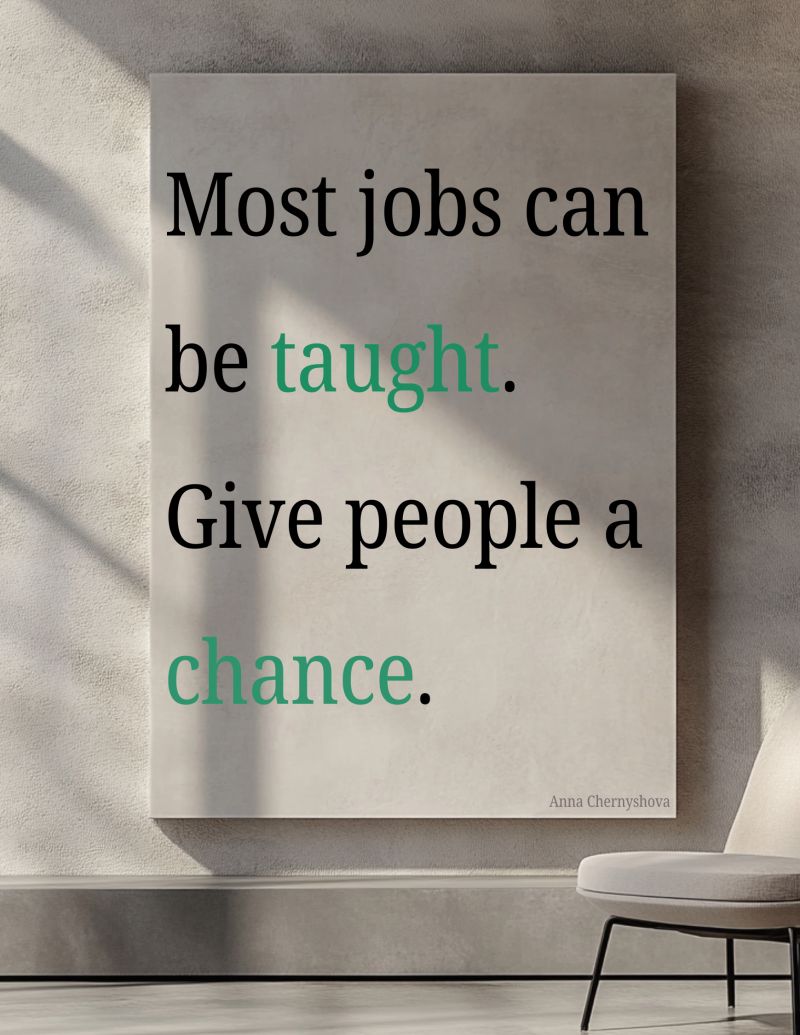
It resonated so deeply because I know firsthand how true it is. Someone once gave me a chance, and it changed the entire course of my career.
In 2018, I was hired as a Training Coordinator for a large social services organization. It was a brand-new role that had never existed before, reporting directly to the Director of Human Resources. On paper, I wasn’t the obvious choice. My background was rooted in social services, not formal training or human resources. I didn’t have years of HR experience or a long list of corporate credentials.
But my future boss saw past the checklist. She recognized something deeper: transferable skills, passion, and a willingness to learn. She believed that with the right guidance and support, I could grow into the role — and beyond.
The Journey After “Yes”
That single “yes” became the catalyst for everything that followed.
As the needs of the position evolved, so did I. Over time, I was promoted from Training Coordinator to Training Manager, taking on expanded responsibilities: creating onboarding programs, launching a Learning Management System (LMS), coaching staff, and leading diversity, equity, and inclusion (DEI) initiatives.
I stayed in that role for six years, growing alongside the department and the organization. When I eventually left, it was with the thought that I wanted to be closer to direct social service again, but I quickly realized something huge. My former boss hadn’t just given me a job. She had helped me uncover my passion: training, development, and helping people grow.
Why Taking a Chance Isn’t a Risk — It’s Smart Leadership
The notion that you must hire someone who has done the exact job before is increasingly outdated. More companies are recognizing that hiring for skills and potential leads to better outcomes than hiring based purely on résumés or degrees.
According to Salary.com, skills-based hiring focuses on what candidates can do, not simply what they’ve done before. It emphasizes competencies, transferable skills, and real-world abilities — and it’s proving to be a better predictor of success in many cases. Similarly, Forbes (2023) highlights that skills-based hiring is on the rise because it helps organizations tap into a broader and more diverse talent pool, offering opportunities to those who might otherwise be overlooked.
McKinsey & Company reinforces this by emphasizing that matching the right skills to the right roles leads to stronger, more agile organizations. It’s not about fitting people into a rigid mold — it’s about recognizing potential and creating space for growth.
What to Look for When Hiring
When organizations open their minds to hiring for potential, they should be looking for indicators like:
- Curiosity and a willingness to learn
- Communication and collaboration abilities
- Problem-solving and adaptability
- Alignment with organizational values and mission
- A growth mindset and resilience
These are the foundations that allow people to succeed once they’re given the right tools, mentorship, and trust.
The Ripple Effect of One “Yes”
My former boss didn’t just fill a role. She created a ripple effect that’s still moving through my life today. She modeled the kind of leader I want to be—someone who recognizes potential, offers mentorship, and trusts people to grow into greatness.
And every time I get to encourage, train, or advocate for someone else, I think of her. I think of what it meant to be seen for who I could be, not just who I was on paper.
So yes—most jobs can be taught.
But belief? Mentorship? The gift of a chance?
That’s what transforms lives.
Further Reflection
If this post resonated with you, consider thinking about:
- What transferable skills have shaped your own path?
- Have you ever benefited from someone giving you a chance?
- Are there people in your life or workplace who show potential but might not check every box yet?
- How can we advocate for skills-based hiring in our own circles?
Sources Cited:
Career Specialist. (2025, March 7). What is Skills-Based Hiring and Why Does It Matter? Salary.com; salary.com. https://www.salary.com/resources/hr-glossary/what-is-skills-based-hiring-and-why-does-it-matter
Castrillon, C. (2023, February 12). Why Skills-Based Hiring Is On The Rise. Forbes. https://www.forbes.com/sites/carolinecastrillon/2023/02/12/why-skills-based-hiring-is-on-the-rise/
Hancock, B., & Weddle, B. (2023, October 25). Skills-based hiring: Right person, Right Role | McKinsey. http://Www.mckinsey.com. https://www.mckinsey.com/capabilities/people-and-organizational-performance/our-insights/right-skills-right-person-right-role
 Help! Send Coffee!