Recently, someone gave me feedback that made me pause and reflect:
“DE&I is just a component of overall culture strategy—it’s not culture in and of itself. Were you a DEI champion or a culture champion?”
It’s a fair question. And it’s one I think many HR professionals and organizational leaders should be asking themselves, especially in today’s climate where both culture and DEI are talked about frequently, sometimes interchangeably, and often without enough nuance.
DEI is culture. But also—it’s not.
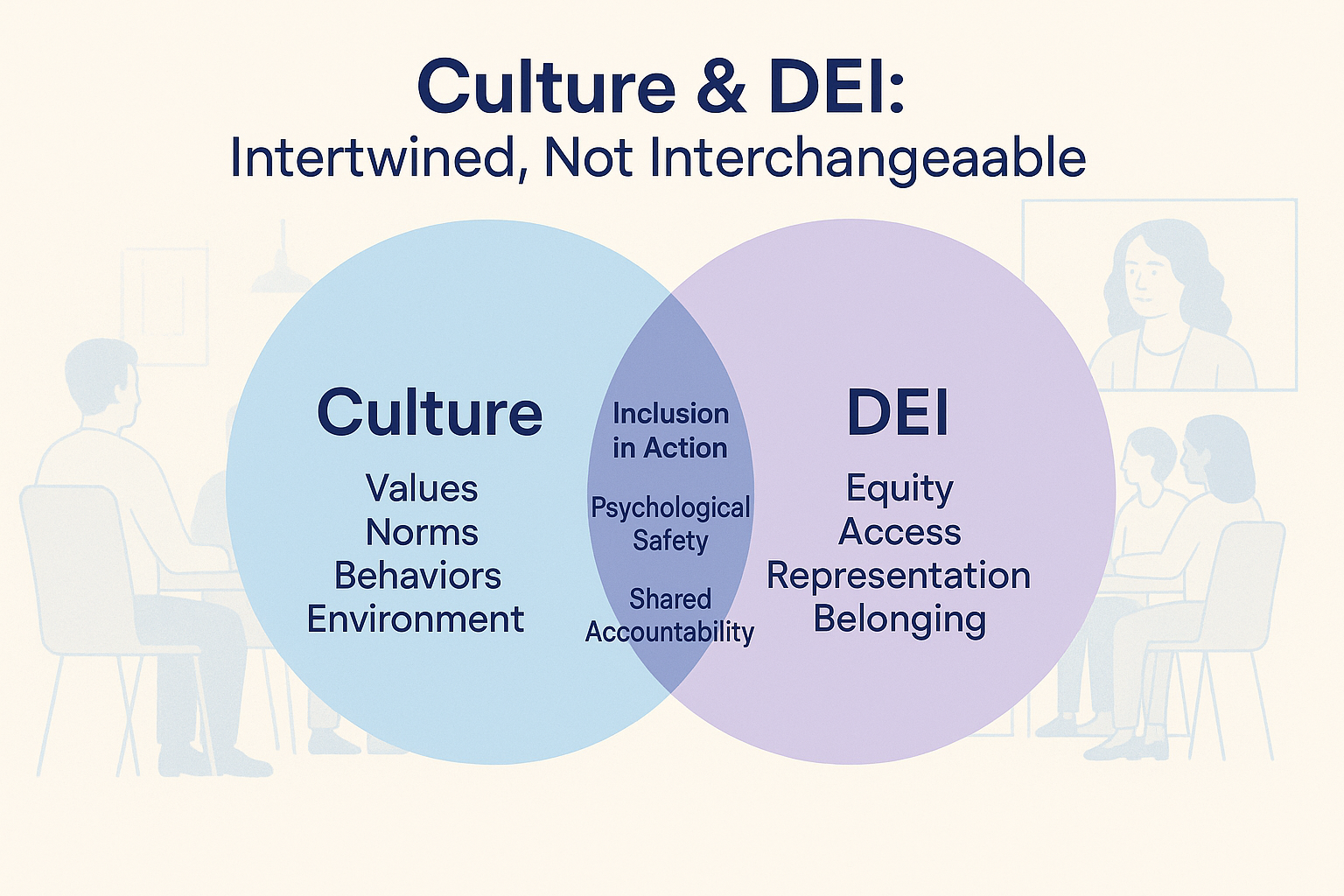
At its core, DEI (Diversity, Equity, and Inclusion) work is about shaping the way people experience the workplace. It’s about creating systems that allow everyone—not just the majority or the loudest—to thrive. That is culture. It’s the lived experience, the values in action, the policies that either support or hinder belonging.
But DEI is also a distinct strategy. It’s not just the “vibe” of a workplace—it’s a framework, a lens, and often, a corrective. You can have a workplace culture that feels positive on the surface but fails to prioritize equity. You can have culture-building initiatives that don’t include DEI, and DEI initiatives that aren’t fully embedded into broader culture work.
As SHRM explains, DEI is essential to creating a strong, resilient culture. A workplace culture without DEI is likely one where some employees feel unseen or undervalued, even if it “looks good on paper.”
Meanwhile, AIHR’s 2025 DEIB guide emphasizes that diversity efforts must be embedded into the very fabric of culture—from leadership behavior to everyday communication to decision-making frameworks.
Here’s how I see it:
- Culture is the overall environment and experience—how people work, communicate, and collaborate.
- DEI is how intentionally inclusive and equitable that culture is: whose voices are valued, whose experiences are centered, and whose needs are considered in policies and practice.
So, to answer the question I was asked, I was both.
When I advocated for accessibility in training, that was DEI and culture.
When I pushed for transparency in promotion criteria, that was DEI and culture.
When I co-led conversations on belonging in staff meetings, that was DEI and culture.
We shouldn’t have to choose between being a “DEI Champion” and a “Culture Champion.” The best work happens when we realize that one informs and strengthens the other.
Final thought:
If we want to build cultures where people thrive, we can’t treat DEI as a checkbox or a siloed initiative. We also can’t talk about culture without asking, “Culture for whom?” That question is where the real work begins.
📚 Further Reading
Here are some thoughtful resources that expand on the relationship between DEI and culture:
- SHRM – The Relationship Between Culture and DE&I
- SHRM – The Role of DE&I in a Strong Company Culture
- SHRM – Why Retreating from Inclusion Is a Mistake for Businesses
- AIHR – Diversity, Equity, Inclusion & Belonging: A 2025 Guide
- AIHR – Focusing on Inclusion and Belonging in the Workplace
- AIHR – How to Measure Company Culture
- NEHRA – DEI Strategy as a Business Imperative
- NEHRA – Beyond DE&I: The Building Blocks of Belonging
 Help! Send Coffee!