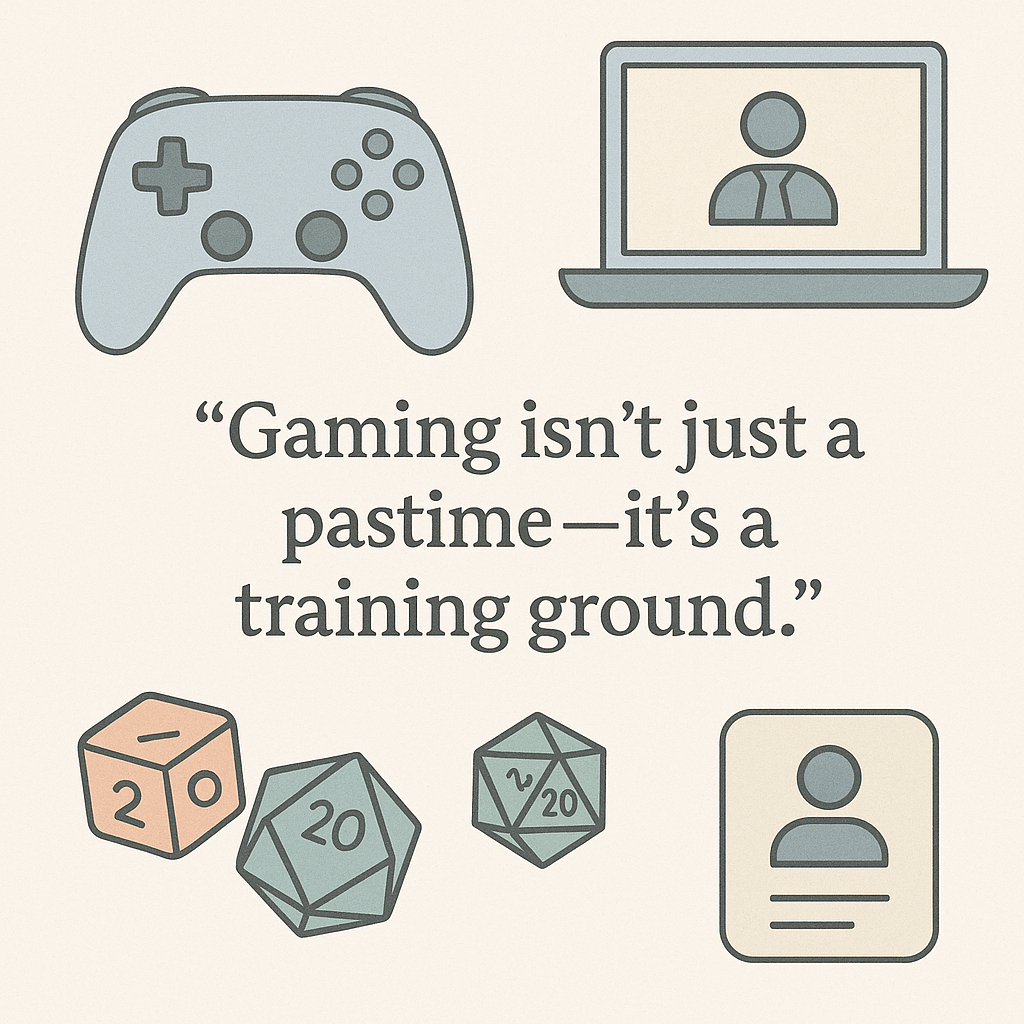
When people hear the word “gamer,” they often picture someone glued to a screen, disengaged from the “real world.” But as someone who has spent several years working as part of a human resources team doing employee development, and also years immersed in both tabletop and video games, I see things a little differently. Games have taught me lessons that formal training programs couldn’t. They’ve helped shape how I think, communicate, and problem-solve at work.
If you’re a fellow gamer, you might be surprised by how many of your favorite experiences have built real-world competencies. If you’re not, here’s a peek behind the curtain into the kinds of skills gamers bring to the table (and why HR professionals should be paying attention).
Strategic Thinking & Planning
Whether you’re navigating the political intrigues of Dragon Age: Origins, managing limited resources in The Witcher 3: Wild Hunt, or planning an elaborate Dungeons & Dragons heist involving three bards and a gelatinous cube, strategic thinking is essential. These games force you to evaluate trade-offs, anticipate obstacles, and pivot when things don’t go according to plan.
Consider a game of Mass Effect, where each dialogue choice or squad deployment can affect both immediate outcomes and long-term consequences. This mirrors strategic planning in business: decisions made today ripple forward and affect future performance.
In HR or project management, we constantly navigate similar territory—choosing initiatives, forecasting outcomes, and adjusting when new data comes in. Gaming has trained me to think holistically, analyze patterns, and expect the unexpected.
Collaboration & Communication
You can’t succeed in most team-based games without collaboration. In Guild Wars 2, every successful dungeon run depends on players knowing their role, sharing resources, and syncing their timing. In D&D, a successful campaign relies on players listening to one another, building on shared goals, and staying in character—even when things get chaotic.
These environments reinforce active listening, trust-building, and peer accountability. You learn how to negotiate conflicting priorities, support others during high-stress encounters, and adapt communication styles to different players. Those same dynamics show up in team meetings, cross-functional collaborations, and even conflict mediation at work.
Even solo games with narrative depth, like Life is Strange, help sharpen communication skills by emphasizing tone, timing, and empathy in conversations, which is valuable when navigating difficult dialogues in real life.
Resilience & Growth Mindset
Games are full of failure. Maybe your crops die in Stardew Valley, your romance options ghost you in Dragon Age, or you choose the wrong ending in Mass Effect because of a forgotten decision made hours earlier. It’s frustrating, but you get back up and try again.
In many RPGs, setbacks aren’t the end—they’re part of the journey. This mindset of iterative improvement is something modern workplaces increasingly prioritize. Failure isn’t viewed as incompetence, but as a stepping stone to innovation and resilience.
In my work, whether designing a training program or navigating employee relations issues, I’ve learned to approach problems with curiosity instead of fear. That resilience – the ability to reflect, recalibrate, and re-engage – is directly influenced by my years of gaming.
Leadership & Initiative
Leadership in gaming often emerges organically. You might not be the “party leader” in D&D, but you’re the one organizing the sessions, tracking loot, or managing the group chat. In Guild Wars, someone has to step up and coordinate roles before a boss fight. In Life is Strange, leadership is more emotional, recognizing your values and sticking by them under pressure.
What all these moments have in common is the idea that leadership isn’t just about authority. It’s about influence, courage, and the willingness to act. These experiences helped me feel confident stepping into leadership roles at work, even when I didn’t have a formal title.
They’ve also shaped how I support others: creating space for teammates to shine, listening for quiet voices, and stepping back when someone else has a better idea. That’s collaborative leadership in action.
Adaptability & Tech Fluency
Every game comes with a learning curve. You have to pick up new mechanics, read patch notes, reassign talent points, or figure out what the heck a “sylvani mushroom” does before it kills you. (Thanks a lot, Witcher series.)
Gamers adapt fast. They learn by doing. They troubleshoot, Google, experiment, and ask for help when needed. These traits are gold in any fast-paced, tech-forward workplace.
In HR, I’ve had to learn new platforms, master compliance updates, and change between tools on a dime. My comfort with experimentation and learning from failure was honed in digital worlds long before I applied it to professional ones.
Emotional Intelligence & Empathy
While often overlooked, gaming has also deepened my emotional intelligence. The narrative arcs in Life is Strange, Mass Effect, and Dragon Age are steeped in choice, consequence, and human connection. These stories put you in morally complex situations, encouraging perspective-taking and self-awareness.
Understanding character motivation, managing group dynamics, and reflecting on how decisions affect others is great practice for any HR professional or team leader. I’ve cried over pixelated goodbyes and carried those emotional lessons into how I hold space for others at work.
Final Thoughts
Gaming isn’t just a pastime, it’s a training ground. Through quests, choices, failures, and friendships, players build the same competencies that workplaces crave: strategy, communication, leadership, adaptability, and empathy.
So whether you’re hiring, job hunting, or simply looking at your own skill set a little differently, remember: the gap between gaming and real-world value isn’t as wide as it seems. For me, gaming hasn’t just made me a better player. It’s made me a better professional, teammate, and leader.
And yes, I’d still absolutely bring three bards and a gelatinous cube to a dungeon crawl. Some risks are just worth it.
 Help! Send Coffee!